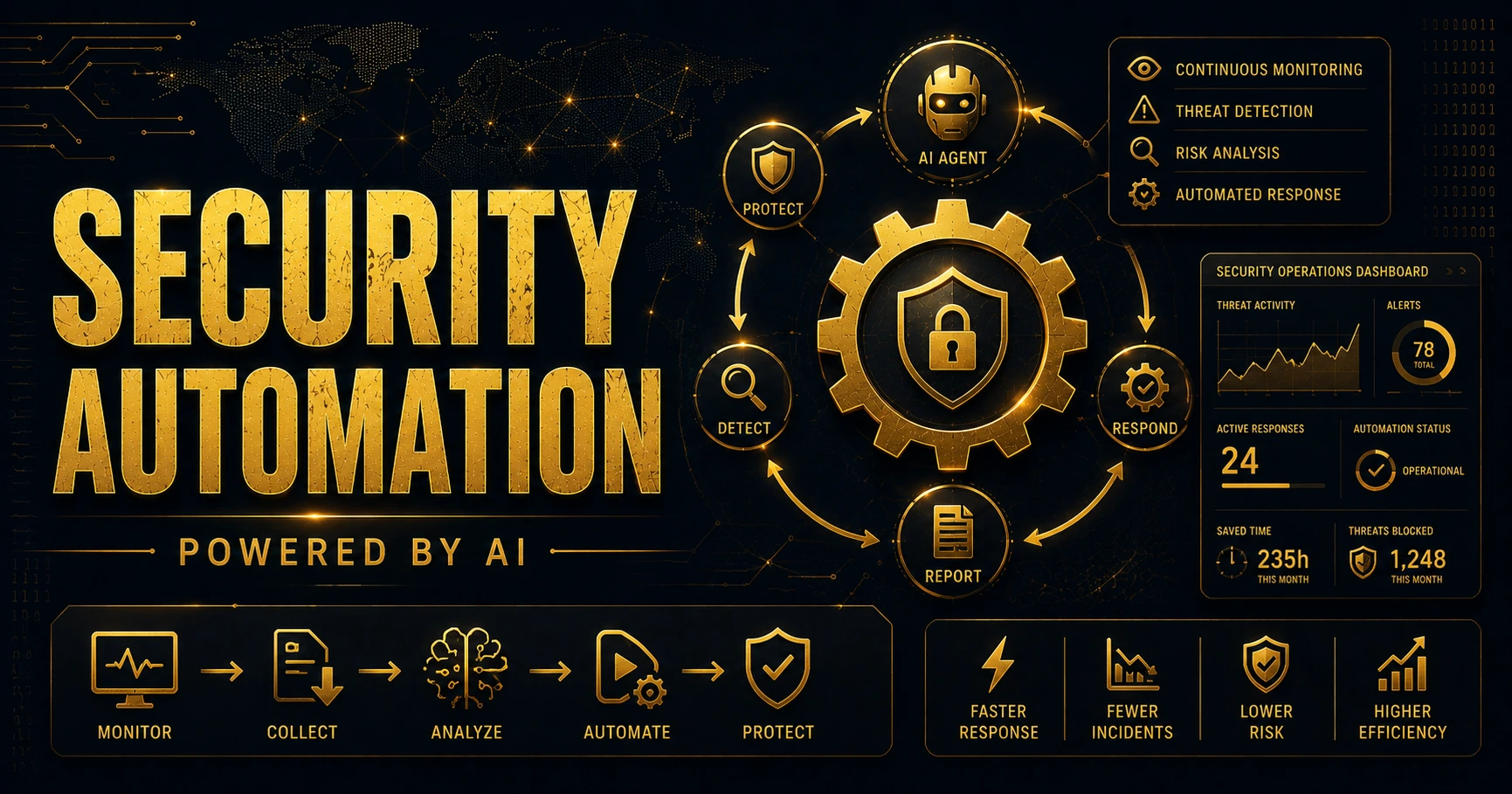
Want to automate your security operations? Contact us — we build custom AI automation solutions for security teams.
The Security Operations Problem
Security teams face a paradox. The volume of threats, alerts, and events they must process grows every year. The tools available to detect threats generate more data than ever before. But the number of skilled security professionals has not kept pace, and the cost of hiring and retaining them continues to rise.
The result is alert fatigue, missed threats, slow response times, and security professionals spending significant portions of their time on repetitive, low-value tasks instead of the complex analysis and decision-making that genuinely requires human expertise.
AI automation does not replace security professionals. It eliminates the parts of their work that should not require human expertise in the first place, freeing them to focus on what only humans can do.
To understand the AI agents behind security automation, read What Are AI Agents.
Learn how AI is being weaponized by attackers in AI-Powered Cyberattacks.
📌 Is Your Personal Device Hacked? If your phone or laptop is overheating, draining battery fast, or you suspect hidden spyware, get professional, 100% confidential help from our Emergency Forensic Investigation & DFIR Team
What Security Operations Can Be Automated?
Not everything in security operations is a candidate for automation. The key is identifying tasks that are repetitive, follow predictable patterns, and do not require the kind of nuanced judgment that human experts provide.
Here are the areas where AI automation delivers the most value in security operations.
Alert Triage and Prioritization
Security tools generate enormous volumes of alerts. The majority are false positives — events that trigger detection rules but represent no actual threat. Manually triaging every alert is time-consuming and unsustainable at scale.
AI agents can automatically evaluate incoming alerts by:
- Checking the alert against threat intelligence feeds to assess whether the indicators are known malicious
- Gathering context from related logs and events to understand whether the alert is part of a broader pattern
- Assessing the severity and potential impact based on the affected systems and data
- Assigning a priority score and recommended action
The result is that human analysts review a prioritized queue of alerts that have already been enriched with context, rather than raw alert data requiring manual investigation.
Log Analysis and Correlation
Modern organizations generate terabytes of log data from endpoints, networks, applications, and cloud services. Manually analyzing this data to identify indicators of compromise is impractical.
AI agents can continuously process log streams, applying pattern recognition to identify anomalies and correlating events across multiple sources to surface meaningful signals. Unlike static rules, AI-based analysis can identify novel patterns that rule-based systems would miss.
Practical applications include:
- Identifying unusual authentication patterns that may indicate credential compromise
- Detecting lateral movement by correlating events across multiple systems
- Flagging data exfiltration attempts based on unusual outbound traffic patterns
- Identifying persistence mechanisms established by attackers
Threat Intelligence Gathering and Processing
Threat intelligence is only valuable if it is current, relevant, and actionable. Keeping up with the volume of threat intelligence available from open sources, vendor feeds, and information sharing communities is a significant challenge for most security teams.
AI agents can automate the intelligence lifecycle:
- Continuously monitoring threat intelligence sources for new indicators and threat actor activity
- Extracting and structuring relevant information from unstructured sources such as security blogs and research reports
- Correlating new intelligence with your specific environment to assess relevance
- Generating structured intelligence reports summarizing key findings and recommended defensive actions
This transforms threat intelligence from a resource-intensive manual process into a continuous, automated capability.
Vulnerability Management
Effective vulnerability management requires identifying vulnerabilities, assessing their severity in the context of your specific environment, and prioritizing remediation based on actual risk rather than generic severity scores.
AI can support this process by:
- Correlating vulnerability scan results with asset inventory and business context
- Assessing exploitability based on threat intelligence about active exploitation
- Generating prioritized remediation recommendations
- Tracking remediation progress and identifying overdue items
The goal is to move from a vulnerability list prioritized by generic CVSS scores to a risk-based view that reflects your actual exposure.
Phishing Detection and Response
Phishing remains one of the most effective attack vectors. AI agents can significantly improve your organizations ability to detect and respond to phishing attempts.
On the detection side, agents can analyze incoming emails in real time, evaluating sender reputation, URL destinations, attachment behavior, and language patterns to identify likely phishing attempts before they reach end users.
On the response side, agents can automatically:
- Quarantine suspected phishing emails across all mailboxes
- Extract indicators of compromise for blocking at the network level
- Alert affected users and provide guidance
- Initiate an investigation workflow for confirmed phishing attempts
Incident Response Workflow Automation
When an incident is confirmed, the first steps of the response process often follow a predictable pattern: gather evidence, isolate affected systems, notify stakeholders, begin investigation. These steps can be partially automated to accelerate response and reduce the burden on human responders.
AI agents can:
- Automatically initiate containment actions when specific incident types are confirmed
- Gather and preserve forensic evidence from affected systems
- Create and populate incident tickets with relevant context
- Notify appropriate stakeholders based on incident type and severity
- Generate initial incident reports
Human responders are still essential for complex investigation and decision-making. But automating the routine initial steps means they can focus on the parts of the response that genuinely require expertise.
How to Get Started with Security Automation
Automating security operations is not an all-or-nothing proposition. The most effective approach is to start with a specific, well-defined use case, demonstrate value, and expand from there.
Step 1: Identify Your Biggest Pain Points Where is your team spending the most time on repetitive, low-value work? What processes are slowing down your response? Start there.
Step 2: Map the Process Before automating a process, document it in detail. What are the inputs? What decisions need to be made? What are the possible outputs? A process that cannot be clearly documented cannot be effectively automated.
Step 3: Start Small and Prove Value Choose a specific, bounded use case for your first automation project. Alert enrichment for a specific alert type, or automated phishing analysis, are good starting points. Demonstrate measurable value before expanding scope.
Step 4: Maintain Human Oversight Design your automation with appropriate human oversight, particularly for consequential actions. Automation should accelerate and support human decision-making, not replace it for high-stakes decisions.
Step 5: Measure and Iterate Define metrics before you start — alert triage time, false positive rate, mean time to respond. Measure them before and after automation. Use what you learn to refine and improve.
The Security Risks of AI Automation
Introducing AI agents into your security operations also introduces new risks that need to be managed.
Prompt Injection Malicious content in your environment can potentially manipulate AI agent behavior. Design your agents to be resistant to prompt injection and test them against adversarial inputs.
Excessive Permissions Agents should only have the access they need to perform their designated functions. Apply the principle of least privilege to agent credentials and tool access.
Audit and Accountability Ensure that agent actions are logged and auditable. You need to be able to understand what your agents did and why, particularly when something goes wrong.
Dependency Risk Over-reliance on automation creates brittleness. Ensure your team maintains the skills and processes to operate effectively if automated systems fail.
How ImrulLabs Can Help
At ImrulLabs, we design and implement AI automation solutions for security operations teams. From alert triage and threat intelligence to phishing detection and incident response automation, we build solutions tailored to your specific environment and needs.
Get in touch to discuss how AI automation can transform your security operations.