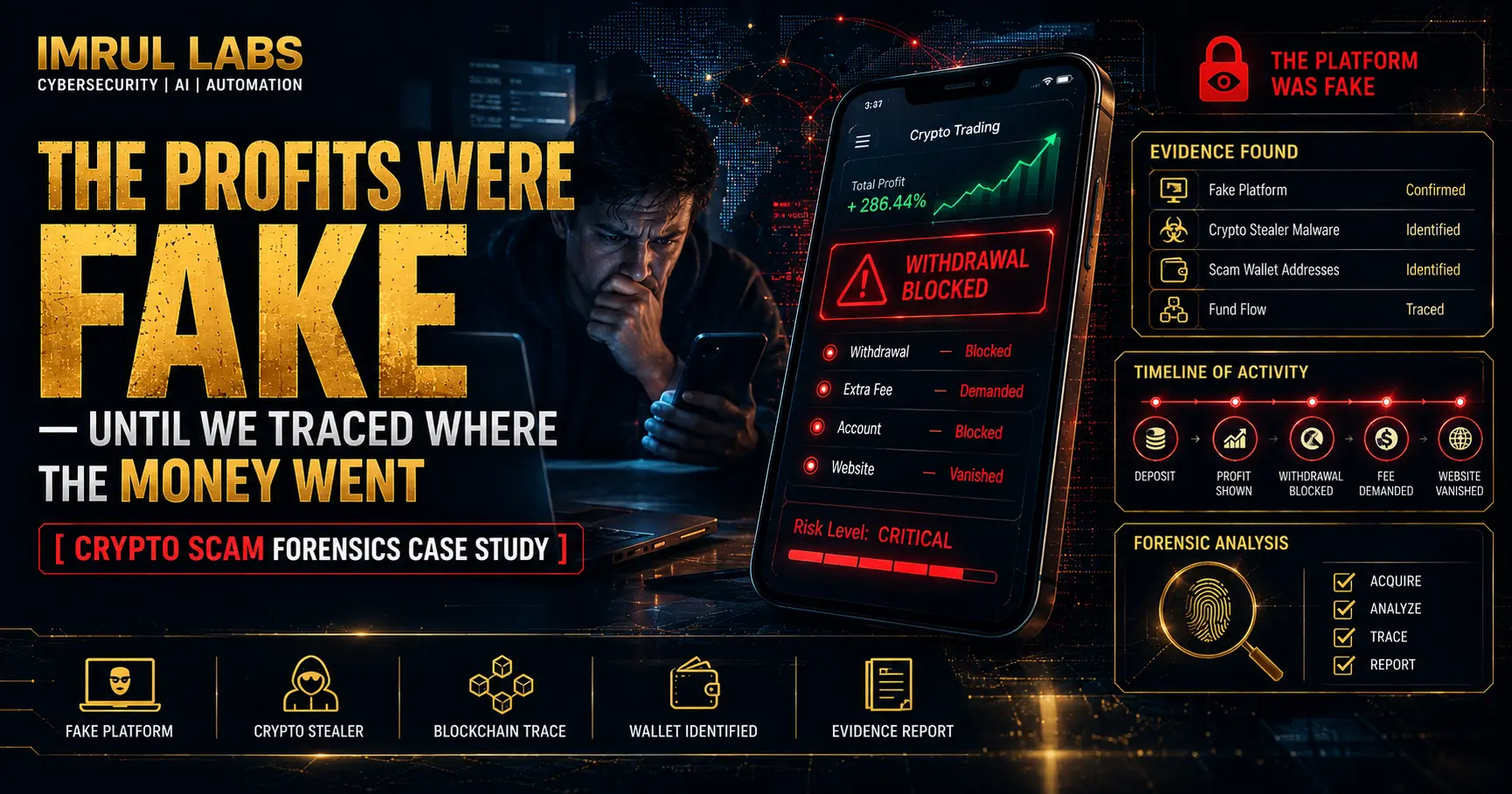
Fake crypto investment platforms are one of the fastest-growing forms of online fraud. They look professional, they show real-looking profits, and they disappear the moment a victim tries to withdraw. In many cases, the scam also involves malware that quietly steals data from the victim’s phone.
In this case study, we walk through how our team at ImrulLabs investigated a fake crypto investment scam that cost a client approximately $180,000 USD, from analyzing the fraudulent website, to identifying crypto stealer malware on the client’s phone, to tracing the stolen funds through blockchain forensics.
Client details have been anonymized and identifying information removed for confidentiality.
The Case at a Glance
- Loss: Approximately $180,000 USD in cryptocurrency
- Scam type: Fake crypto trading and investment platform
- Tactics used: Early fake profits, blocked withdrawals, an “advance fee” demand of $30,000, account blocking, and website takedown
- Additional threat: A malicious application on the client’s phone that deleted itself after installation
- Our work: Website and infrastructure analysis, mobile malware analysis, crypto transaction tracing, and identification of scam wallet addresses
How the Fake Crypto Investment Scam Worked
Stage 1: Early Profits Build Trust
The client invested through a professional-looking crypto trading website. In the beginning, the platform showed profits and allowed some early returns. This is a deliberate tactic used in fake crypto investment scams. Small early wins build confidence and push victims to deposit much larger amounts.
Stage 2: Withdrawals Stop
When the client tried to withdraw profits, the platform stopped paying out.
Stage 3: The “Pay $30,000 to Withdraw” Trap
The platform’s customer care told the client that the investment could be withdrawn only after paying an additional $30,000. This is the classic advance fee scam pattern. Legitimate platforms deduct fees from your existing balance. They do not demand new deposits to release your own money. The money is never released, and the demand exists only to extract more.
Stage 4: Account Blocked, Website Vanished
When the client refused to pay, the platform blocked the client’s username and account. Soon after, the website disappeared completely.
Investigation Part 1: Analyzing the Fake Crypto Investment Website
After the site went offline, we examined everything that could still be recovered: domain and hosting information, archived and cached copies of the site, the client’s screenshots, and saved communications.
The analysis confirmed that the platform was not a real trading service. It was a fraudulent website operated by an organized crypto scam group, using a fake dashboard, fake profit displays, and scripted “customer care” support to manage victims through each stage of the scam.
Investigation Part 2: The Vanishing App and Crypto Stealer Malware
One detail stood out. The scammers had guided the client into installing an application on their mobile phone. Later, that application disappeared from the device.
Apps that hide or delete themselves after doing their job are a strong warning sign. We performed a forensic examination of the device and analyzed the application. Our investigation identified it as crypto stealer and information-stealing malware.
This type of malware is designed to:
- Harvest cryptocurrency wallet data and related information
- Collect saved credentials and other sensitive information from the device
- Operate quietly and remove visible traces of itself after execution
This finding was significant for two reasons. First, it showed that the scam went beyond a simple investment fraud. The client’s device, wallets, and personal data were also at risk. Second, it provided strong additional evidence that the platform was part of a deliberate, organized criminal operation.
As a precaution, the client was advised to move any remaining crypto assets to new wallets created on a clean device, change passwords and credentials from a secure device, and enable two-factor authentication on all important accounts.
Investigation Part 3: Blockchain Forensics and Crypto Tracing
The third part of the investigation was tracing the stolen cryptocurrency. Blockchain transactions are public and permanent, which makes it possible to follow the movement of funds even when the scam website is gone.
Our process included:
- Documenting the deposits. Every transaction hash, wallet address, amount, and timestamp related to the client’s payments was recorded.
- Following the flow of funds. We traced the funds forward from the client’s deposits through the wallets that received them.
- Analyzing transaction patterns. We examined how funds were consolidated, split, and moved between wallets, and looked for behavior commonly associated with scam operations.
- Identifying the scam wallet addresses. The investigation identified the wallet addresses used by the fraudulent platform, and these were documented in a structured forensic report.
What Blockchain Forensics Can and Cannot Do
Blockchain analysis can show where funds went and which addresses were involved. It cannot, on its own, name the person behind a wallet. Identifying individuals and recovering funds requires the cooperation of exchanges, payment providers, and law enforcement. Where funds reach a regulated exchange, that is where formal legal requests can be directed, which is why an evidence-based forensic report is so important.
The Result
The engagement delivered:
- A complete picture of the scam, from the fake platform to the malware on the client’s phone
- Confirmed identification of the malicious application as crypto stealer and information-stealing malware
- A documented blockchain trace with the identified scam wallet addresses
- A structured report the client could use when reporting the case to law enforcement and relevant platforms
We are always transparent with clients on one point: recovery of stolen crypto is never guaranteed. It depends on how quickly the victim acts, where the funds moved, and how exchanges and authorities respond. What forensic work does provide is evidence, clarity, and the strongest possible foundation for any recovery or legal effort.
Red Flags of a Fake Crypto Investment Platform
- Guaranteed or unusually high returns. Real investments always carry risk.
- Small early profits followed by withdrawal problems. This is the most common pattern in fake crypto platforms.
- Requests to pay a fee, tax, or “verification deposit” before withdrawing. This is a scam signal in almost every case.
- Instructions to install an app from outside the official app stores. Legitimate platforms do not ask for this.
- Pressure and urgency. Scammers rush victims so they do not stop to verify.
- Support only via chat groups. Fake platforms often rely on messaging groups instead of a verifiable company presence.
Need Help Tracing Stolen Crypto or Investigating a Crypto Scam?
If you have lost money to a fake crypto investment platform, do not send any more funds, and preserve all evidence, including chats, website screenshots, wallet addresses, and transaction hashes.
For professional blockchain forensics and crypto scam investigation, contact us through Imrul Labs — Every Digital Incident Leaves Evidence. We Find It.
You can also explore our related services:
- OSINT & Online Fraud Investigation
- Mobile Device Forensics (iOS & Android)
- Emergency Incident Response & Digital Forensics
For more case studies and security guides, browse the rest of the ImrulLabs Blog.
Frequently Asked Questions
Can stolen cryptocurrency be traced? Yes. Public blockchains record every transaction permanently, so investigators can follow the movement of stolen funds between wallets. Tracing shows where the money went, but it does not automatically reveal who controls a wallet or guarantee recovery.
Can I get my money back after a fake crypto investment scam? Recovery is never guaranteed. Outcomes depend on how fast you act, whether funds are still at an exchange, and how exchanges and law enforcement respond. A forensic report gives you the strongest evidence to support a police report or a formal request to an exchange.
How do I know if a crypto investment platform is fake? Warning signs include guaranteed returns, withdrawal problems after early profits, demands for extra fees or taxes before you can withdraw, pressure to act quickly, and instructions to install unofficial apps. If a platform asks you to pay more to access your own money, treat it as a scam.
What is crypto stealer malware? Crypto stealer malware is a type of information-stealing software designed to collect cryptocurrency wallet data, saved credentials, and other sensitive information from an infected device. Some versions hide or delete themselves after running, which makes them hard to spot without a forensic examination.
What should I do immediately if I think I was scammed on a crypto platform? Stop sending money, and do not pay any “release” or “verification” fee. Save all chats, screenshots, wallet addresses, and transaction hashes. Move remaining assets to new wallets created on a clean device, change your passwords from a secure device, enable two-factor authentication, and report the incident to local law enforcement and your national cybercrime portal.
Should I trust companies that promise guaranteed crypto recovery? No. Anyone promising guaranteed recovery, especially for an upfront fee, may be running a second scam targeting victims. A legitimate investigator will explain honestly what can and cannot be done.
Why choose ImrulLabs for a crypto scam investigation? At ImrulLabs, every investigation is led directly by our founder and senior engineer, with 7+ years of experience and 130+ cases resolved. We combine blockchain forensics, malware analysis, and OSINT, and we keep every engagement remote and confidential.
Lost money to a fake crypto platform or suspect crypto stealer malware on your device? ImrulLabs provides confidential, evidence-based investigation for individuals and businesses. Book an Emergency Consultation →